_Follow along with this video:_ --- ### totalSupply > 0 Now that things are set up and we've performed our sanity check, let's start writing some of the invariants we want to apply to our NftMock contract. Don't lose sight of our game plan! 1. Warm up by verifying some stats of our NFTMock 1. Sanity Checks 2. Total Supply is never negative 3. Minting mints 1 NFT 4. Parametric Example 2. Formally Verify a lot of stuff for GasBadNFTMarketplace 1. Anytime a mapping is updated, we emit an event 2. Calling ANY function on GasBadNFTMarketplace or NFTMarketplace, leaves the protocol in the same state `totalSupply` is a perfect simple test case for our formal verification. It's a single function that the prover can check like mad. Let's write out our methods block and invariant in `NftMock.spec`. ```js /* * Verification of NftMock */ methods { function totalSupply() external returns uint256 envfree; } invariant totalSupplyIsNotNegative(){ totalSupply() >= 0; } // rule sanity { // satisfy true; // } ``` Now we just need to run the prover. ```bash certoraRun ./certora/conf/NftMock.conf ``` This to me is the real power of Certora. We didn't need to do any major set up, we didn't have to worry about contract deployments, nothing. A simple one liner defining our invariant is all we need. You may receive an error at this point when you run the prover as it may detect an `unwinding loop` in our contract. The prover is detecting possible `reentrancy` through the `onERC721Received` function. We know this to be unimpactful in our code base, so we can avoid this error through further adjusting our `NftMock.conf` file. ```js { "files": [ "./test/mocks/NftMock.sol" ], "verify": "NftMock:./certora/spec/NftMock.spec", "wait_for_results": "all", "msg": "Verification of NftMock", "rule_sanity": "none", "optimistic_loop": true } ``` By sidestepping this loop being detected we should see things pass...  ...and our job passes without errors! Although, if we turn our `rule_sanity` back to `basic`, what do you think is going to happen? 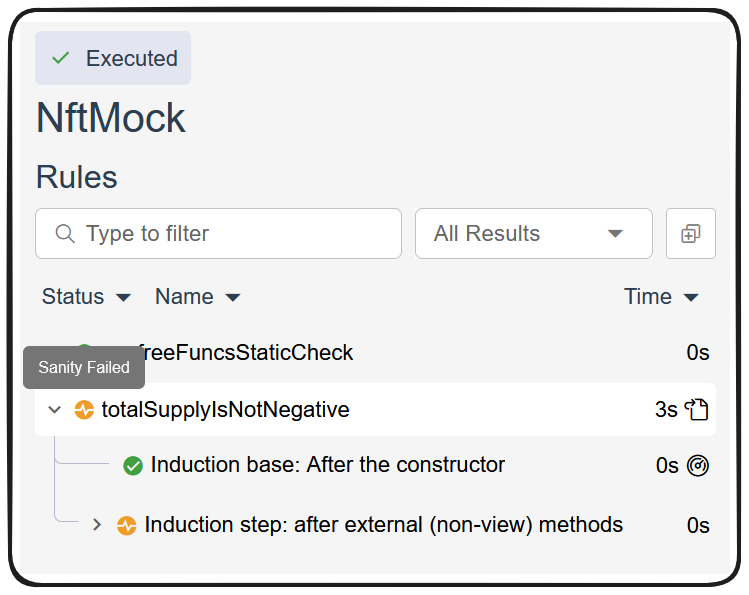 ### Wrap Up We failed our vacuity check! Of course totalSupply is going to be positive, it's a uint256 based on the length of an array! Kind of a silly thing to verify, but an amazing test for us to build our familiarity with the process nonetheless. In the next lesson we'll try something with a little more meat and verify that minting an NFT only mints a single NFT. Let's go!
Follow along with this video:
totalSupply > 0
Now that things are set up and we've performed our sanity check, let's start writing some of the invariants we want to apply to our NftMock contract. Don't lose sight of our game plan!
Warm up by verifying some stats of our NFTMock
Sanity Checks
Total Supply is never negative
Minting mints 1 NFT
Parametric Example
Formally Verify a lot of stuff for GasBadNFTMarketplace
Anytime a mapping is updated, we emit an event
Calling ANY function on GasBadNFTMarketplace or NFTMarketplace, leaves the protocol in the same state
totalSupply is a perfect simple test case for our formal verification. It's a single function that the prover can check like mad. Let's write out our methods block and invariant in NftMock.spec.
Now we just need to run the prover.
This to me is the real power of Certora. We didn't need to do any major set up, we didn't have to worry about contract deployments, nothing. A simple one liner defining our invariant is all we need.
You may receive an error at this point when you run the prover as it may detect an unwinding loop in our contract. The prover is detecting possible reentrancy through the onERC721Received function. We know this to be unimpactful in our code base, so we can avoid this error through further adjusting our NftMock.conf file.
By sidestepping this loop being detected we should see things pass...

...and our job passes without errors! Although, if we turn our rule_sanity back to basic, what do you think is going to happen?

Wrap Up
We failed our vacuity check! Of course totalSupply is going to be positive, it's a uint256 based on the length of an array! Kind of a silly thing to verify, but an amazing test for us to build our familiarity with the process nonetheless.
In the next lesson we'll try something with a little more meat and verify that minting an NFT only mints a single NFT.
Let's go!
totalSupply > 0
In this video, Patrick demonstrates the process of creating invariants or rules for smart contracts using Certora, ensuring that the total supply of NFT tokens is never negative.

Certora Syntax Update
Last updated on January 17, 2025
Course Overview
About the course
What you'll learn
Assembly
Writing smart contracts using Huff and Yul
Ethereum Virtual Machine OPCodes
Formal verification testing
Smart contract invariant testing
Halmos, Certora, Kontrol
Course Description
Who is this course for?
- Smart contract security researchers
- Advanced Smart contract engineers
- Chief Security Officiers
- Security professionals
Potential Careers
Security researcher
$49,999 - $120,000 (avg. salary)
Smart Contract Auditor
$100,000 - $200,000 (avg. salary)
Meet your instructors

Guest lecturers:

Last updated on February 1, 2026


Course Overview
About the course
What you'll learn
Assembly
Writing smart contracts using Huff and Yul
Ethereum Virtual Machine OPCodes
Formal verification testing
Smart contract invariant testing
Halmos, Certora, Kontrol
Course Description
Who is this course for?
- Smart contract security researchers
- Advanced Smart contract engineers
- Chief Security Officiers
- Security professionals
Potential Careers
Security researcher
$49,999 - $120,000 (avg. salary)
Smart Contract Auditor
$100,000 - $200,000 (avg. salary)
Meet your instructors
Guest lecturers:
Last updated on February 1, 2026