_Follow along with this video:_ --- ### Manually verify a smart contract on Block Explorers Soooo ... we just deployed our smart contract on Sepolia, let's check it out! > **Note:** This lesson demonstrates verification on Etherscan, the most widely used block explorer. The process is nearly identical on Blockscout and other explorers. Later, we'll learn how to verify programmatically using Foundry, which supports multiple explorers. We go [here](https://sepolia.etherscan.io/address/0x1093560Fe9029c4fB9044AbF2fC94288970D98Db#code) click on `Contract` and find this: 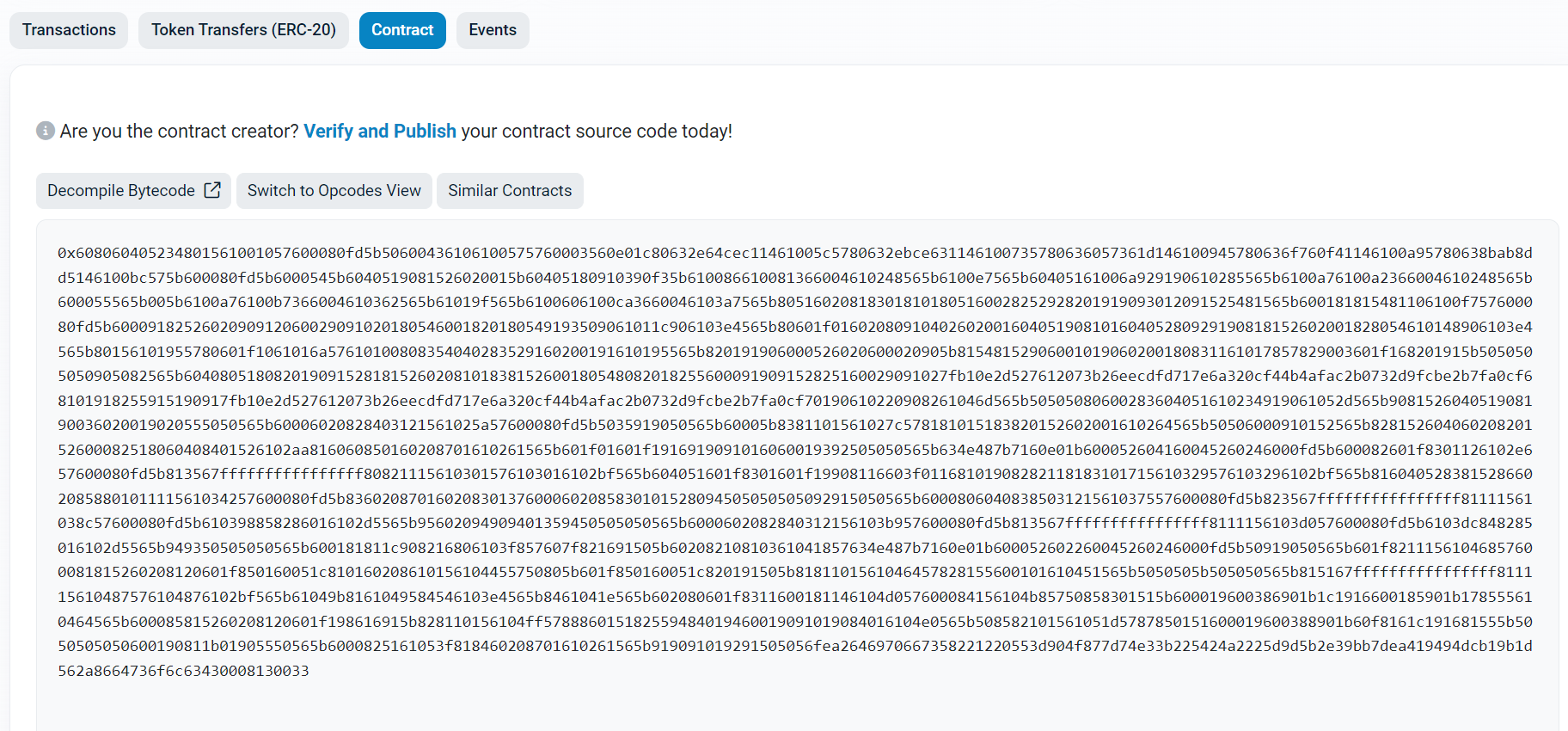 This bytecode looks horrendous. We need to do something to improve the readability (which currently is non-existent). Etherscan is prompting us to do something about it via the message: `Are you the contract creator? Verify and Publish your contract source code today!` So, let's click on `Verify and Publish`. The address of the Contract comes prepopulated, if not please paste it from your terminal. Select `Solidity(Single file)` because we are using solidity and we have only one file. Select your Compiler Version. My contract used solidity 0.8.19. The license type we used is MIT. On the next page, paste your Solidity Contract. Select `Yes` in `Optimization`, and leave everything else as is. Finish up the `verify` process. If you get this message: ``` Successfully generated Bytecode and ABI for Contract Address [0x1093560Fe9029c4fB9044AbF2fC94288970D98Db] ``` you did it right! Now you have access to the `Read Contract` and `Write Contract`. This lets you interact directly with your contract through the block explorer. Congratz! You just learned how to verify a smart contract, the manual way. This is not the ideal way, in the future, we will teach you how to verify them programmatically.
Follow along with this video:
Manually verify a smart contract on Block Explorers
Soooo ... we just deployed our smart contract on Sepolia, let's check it out!
Note: This lesson demonstrates verification on Etherscan, the most widely used block explorer. The process is nearly identical on Blockscout and other explorers. Later, we'll learn how to verify programmatically using Foundry, which supports multiple explorers.
We go here click on Contract and find this:

This bytecode looks horrendous. We need to do something to improve the readability (which currently is non-existent).
Etherscan is prompting us to do something about it via the message: Are you the contract creator? Verify and Publish your contract source code today!
So, let's click on Verify and Publish.
The address of the Contract comes prepopulated, if not please paste it from your terminal.
Select Solidity(Single file) because we are using solidity and we have only one file.
Select your Compiler Version. My contract used solidity 0.8.19.
The license type we used is MIT.
On the next page, paste your Solidity Contract. Select Yes in Optimization, and leave everything else as is.
Finish up the verify process. If you get this message:
you did it right!
Now you have access to the Read Contract and Write Contract. This lets you interact directly with your contract through the block explorer.
Congratz! You just learned how to verify a smart contract, the manual way. This is not the ideal way, in the future, we will teach you how to verify them programmatically.
Verify a Smart Contract on Etherscan
A foundational guide to Manually Verifying Your Smart Contract on Etherscan - Learn the importance of Etherscan verification and follow the detailed manual steps to publish your source code. Understand how verification builds trust and enables direct contract interaction via Etherscan's Read/Write tabs.

Course Overview
About the course
What you'll learn
Foundryup, Foundry Forge, and Anvil
Blockchain Oracles
How to create local Blockchain testnets
How to verify a smart contract
How to write and run smart contract tests
Course Description
Who is this course for?
- Software engineers
- Web3 developers
- Blockchain security researchers
Potential Careers
Security researcher
$49,999 - $120,000 (avg. salary)
Smart Contract Engineer
$100,000 - $150,000 (avg. salary)
Web3 developer
$60,000 - $150,000 (avg. salary)
Web3 Developer Relations
$85,000 - $125,000 (avg. salary)
Smart Contract Auditor
$100,000 - $200,000 (avg. salary)
Meet your instructors

Guest lecturers:


Last updated on February 1, 2026


Course Overview
About the course
What you'll learn
Foundryup, Foundry Forge, and Anvil
Blockchain Oracles
How to create local Blockchain testnets
How to verify a smart contract
How to write and run smart contract tests
Course Description
Who is this course for?
- Software engineers
- Web3 developers
- Blockchain security researchers
Potential Careers
Security researcher
$49,999 - $120,000 (avg. salary)
Smart Contract Engineer
$100,000 - $150,000 (avg. salary)
Web3 developer
$60,000 - $150,000 (avg. salary)
Web3 Developer Relations
$85,000 - $125,000 (avg. salary)
Smart Contract Auditor
$100,000 - $200,000 (avg. salary)
Meet your instructors
Guest lecturers:
Last updated on February 1, 2026